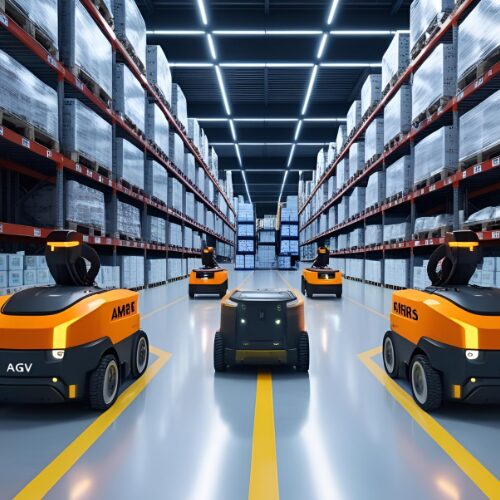
Enhancing AGV and AMR Safety: Understanding ISO 3691-4:2023

Introduction

Automated Guided Vehicles (AGVs) and Autonomous Mobile Robots (AMRs) are transforming industries by optimising logistics, warehousing, and manufacturing processes. However, as these systems operate alongside human workers, safety becomes a crucial concern and priority. The ISO 3691-4:2023 standard provides a comprehensive framework for ensuring the safe design, integration, and operation of these driverless vehicles. In this blog, we explore the key aspects of ISO 3691-4:2023 and its impact on AGV/AMR safety. 

Understanding ISO 3691-4:2023

ISO 3691-4:2023 is an international safety standard that outlines essential requirements for industrial automated vehicles, ensuring their safe interaction with humans and other equipment. It covers various aspects such as risk assessment, functional safety, and performance validation for AGVs and AMRs operating in shared environments. 

Key Requirements of ISO 3691-4:2023

Risk Assessment and Hazard Mitigation

  • Identifies potential hazards associated with AGV/AMR operation. 
  • Requires manufacturers and integrators to conduct a thorough risk assessment. 
  • Focuses on mitigating collision risks, entrapment hazards, and system failures. 

Functional Safety Measures

  • Defines performance levels (PL) and safety integrity levels (SIL) for AGV/AMR safety functions. 
  • Ensures proper implementation of safety-rated sensors, braking systems, and obstacle detection. 
  • Emphasises redundancy in critical safety functions to minimise single-point failures. 

Navigation and Environmental Awareness

  • Requires AGVs/AMRs to reliably detect and respond to obstacles in dynamic environments. 
  • Specifies criteria for sensor performance, including LiDAR, cameras, and ultrasonic sensors. 
  • Includes provisions for emergency stop functions and safe speed adjustments. 

Human-Machine Interaction and Operator Safety

  • Establishes guidelines for collaborative operation between AGVs/AMRs and human workers. 
  • Recommends clear visual and auditory signalling for AGV/AMR presence and movement. 
  • Defines safe operational zones and restricted access areas to prevent accidents. 

Validation and Performance Testing

  • Requires rigorous testing procedures before AGVs/AMRs are deployed. 
  • Ensures compliance with braking distances, acceleration limits, and emergency stop functions. 
  • Includes periodic maintenance and safety audits to sustain long-term operational safety. 

Benefits of Implementing ISO 3691-4:2023

Enhanced Workplace Safety: By adhering to the standard, businesses can significantly reduce workplace accidents, ensuring AGVs and AMRs operate safely around human workers. 

Regulatory Compliance and Liability Reduction: Compliance with ISO 3691-4:2023 helps manufacturers and operators meet global safety regulations, minimising legal and financial risks. 

Improved Operational Efficiency: Safety compliance results in fewer disruptions due to accidents or breakdowns, leading to increased efficiency and productivity. 

Greater Trust in Automation: Following standardised safety protocols fosters trust among employees, making them more willing to work alongside AGVs and AMRs. 

Conclusion

ISO 3691-4:2023 is a vital standard for ensuring the safe and efficient operation of AGVs and AMRs in industrial environments. By implementing its guidelines, businesses can enhance workplace safety, achieve regulatory compliance, and optimise the performance of their automated systems. As technology evolves, continuous adherence to safety standards will be essential in fostering a seamless and secure transition toward automation. 

For businesses looking to integrate AGVs and AMRs, compliance with ISO 3691-4:2023 is not just a recommendation—it’s a necessity for a safer and more productive future. 

The New ISO 10218:2023 Standards: Enhancing Robotic Safety in Industrial Environments


In today’s industrial landscape, robots are more integral to production than ever before. The rise of automation and collaborative robotics (cobots) has driven the need for more robust safety standards. To address these evolving challenges, the ISO 10218 standards, which govern the safety of industrial robots, received an update in 2023. The new ISO 10218-1:2023 and ISO 10218-2:2023 standards offer improved guidance for manufacturers, system integrators, and end-users of robots, ensuring that robots can function safely alongside human workers and within broader automated systems. 

What is ISO 10218? 

The ISO 10218 series consist of two primary parts: 

1. ISO 10218-1:2023 addresses the safety requirements for the robotic manipulator, controller and teaching pendant, particularly for manufacturers of industrial robots.

2. ISO 10218-2:2023 provides guidelines for the integration of robots into complete systems and workplaces, primarily focusing on system integrators and machine builders. 

Both standards ensure that robots meet critical safety benchmarks, protecting both the humans working near them and the systems they interact with. 

Key Updates in the 2023 Edition 

The 2023 revision of ISO 10218 brings about several significant changes aimed at improving both the functionality and safety of industrial robots in modern applications. The key updates focus on risk assessment, collaborative robotics, and cybersecurity. 

  1. Risk-Based Flexibility

One of the most notable changes in ISO 10218:2023 is the introduction of more flexible requirements based on the risk level of the application. This is particularly important for collaborative robots, which often work in close proximity to humans. The standard no longer prescribes rigid safety functions for all applications. Instead, it allows the performance level to be derived through a comprehensive risk assessment, ensuring safety measures are tailored to the specific risks presented by each application​. 

  1. Collaborative Robot Safety

The rise of collaborative robots, or cobots, has necessitated new safety approaches. ISO 10218-1:2023 and ISO 10218-2:2023 incorporate provisions from ISO/TS 15066, which specifically addresses the safe design of collaborative robots. These new guidelines provide more detailed requirements for ensuring safe interaction between humans and robots. They include safety measures for mitigating risks associated with physical contact and detailed instructions on designing safe workspaces​. 

  1. Cybersecurity Integration

As robots become more connected, cybersecurity has emerged as a crucial consideration. The updated ISO 10218-1:2023 now includes requirements to protect robots from unauthorized access. Cyberattacks can cause robots to malfunction, potentially leading to safety risks. The standard references the IEC 62443 series, which outlines security measures for industrial control systems, ensuring that the robot’s control systems are protected from external threats​. 

  1. New Functional Safety Requirements

The updated standards also introduce new functional safety requirements. For example, robots must have at least two operational modes—manual and automatic—with specific safety conditions for switching between them. In particular, the use of off-on-off switches is of particular importance to the safety of robots and cobots both in training the system and during normal function. Additionally, new guidelines now govern safe handling, storage, and transportation of robots, further enhancing the overall safety framework. 

  1. Expanded Safety Functions

Another new feature is the mandatory inclusion of certain safety functions, such as the “normal stop” function, which is now required in all robots to ensure quick and safe halts in operation. This is a significant addition to the safety features required under previous versions of the standard. 


Conclusion

The new ISO 10218-1:2023 and ISO 10218-2:2023 standards represent a crucial step forward in ensuring the safety of industrial robots. By incorporating risk-based flexibility, enhanced guidelines for collaborative robots, and cybersecurity requirements, these standards provide a comprehensive framework for safe robotic operations. As automation continues to grow, adherence to these standards will be essential for manufacturers, integrators, and end-users alike, ensuring that industrial robots can safely and effectively collaborate with humans and other systems in the workplace. 

Live Electronics Ltd works with manufacturer IDEC to supply industry leading enabling (off-on-off) switches, safety interlocks and laser systems along with their safety commander offering the ability to use a modern tablet while retaining safety functionality such as enabling switches and estops.